Dad, I learned I did not like it!
My son was in the thick of elementary school—grade three or four, if memory serves. The dreaded progress report came home, and as is tradition in our household, we dissected it over dinner. His English grade? Let’s just say it was less than stellar, certainly not what my wife and I were expecting from our little scholar.
"Why the low mark?" we asked.
His reply was a verbal shrug: "I learned it last year."
"If you learned it last year," I countered, my voice edged with parental logic, "your grade should be higher."
That’s when he delivered the punchline, a moment of pure, unscripted brilliance: "Dad, I learned that I did not like it."
Conversation over. In a flash, my son had turned a moment of awkward parental tension into something productive and hilarious, all thanks to a perfectly timed, witty retort.
A leader who can pull off a move like that—who can understand and wield humour to pivot tension into a positive outcome—is rarely the one advertised on a job posting. You won't find "Jester" on the list of desired leadership traits. And yet, the successful use of humour is a flashing neon sign for a suite of highly sought-after qualities: empathy, emotional intelligence, assertiveness, and stellar relationship skills.
Of course, humour in the workplace is a high-wire act. When executed flawlessly, it turbocharges a team; when it lands wrong, it can torch credibility and relationships faster than a bad corporate merger. In our current work environment, most leaders seem to complete the risk assessment and decide to keep their funny bone holstered, opting for silence over the potential hazard of a poorly landed joke.
What’s fascinating is that the core ingredients of good humour are the exact same as the core ingredients of good conflict resolution. To be genuinely funny requires sharp assertive communication (perfect tone, impeccable timing, crystalline clarity) and top-tier relational skills (empathy, respect, connection).
The better a leader is at these fundamental skills, the more forms of humour they can deploy successfully, and the lower the risk of causing offense. When these foundational skills are lacking, the humour doesn't disappear; it just gets narrower and significantly riskier. Think of what delights children: it’s often pure slapstick. A burp, a fart, or a well-executed pratfall can provide kids with endless delight. Adults can find this funny too, but the joke wears thin fast.
To ensure humour has a positive leadership impact, there are a few non-negotiables:
Timing is Everything: Just like Goldilocks’ porridge, the joke must be delivered just right.
Know Your Audience: The style of humour must be tailored precisely to the people and the situation.
Don’t Force It: Trying too hard isn't charming; it’s desperate, and it has the opposite of the desired effect.
Now, let's dive into some common types of humour and see how they connect to assertiveness and relationship mastery.
The Four Quadrants of Humour and Leadership:
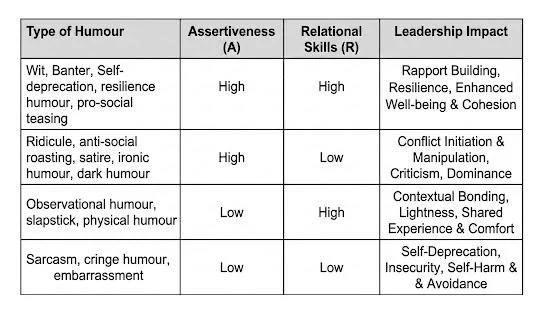
Picture the perfect leader: someone who consistently hits the 'sweet spot'—high on connection, high on confidence, where every witty remark is perfectly timed, crystal clear, and lands with a punch of empathy and respect. That's the ideal, the leadership unicorn. But let's be real, managing the emotional wattage to stay there 24/7 is exhausting, even for the best.
The good news? Leadership humour doesn't have to be a marathon. Sometimes it’s the low-energy, observational chuckle or a bit of physical comedy—the shared eye-roll over a common frustration—that builds those vital connections. And yes, even the sharp edges of humour—sarcasm, the gentle roast—can be a signal, a flashing light on the leadership dashboard. I’ve always believed that things are funny because they hold a kernel of uncomfortable truth. A smart leader doesn't shut down the negativity; they decode it. It’s often a desire, a plea, for things to get better.
So, Why Bother Being Funny?
It’s not just about the belly laughs, though those are great for your health (hello, tension release!). Laughter is the ultimate social glue. It’s contagious, it sticks in people’s memories, and it’s the engine that keeps people connected during the white-knuckle ride of transformational leadership. Humour is the ultimate multi-tool, allowing people:
To challenge
To console
To engage
To vent (safely!)
To motivate
To question
To explore
To express
And to drop a lifeline of care and compassion.
Given this powerful toolkit, why are so many workplaces as dry as a week-old scone? If you don’t hear daily laughter in your office, I’ll bet the house that you don't have great leadership there either. Leaders don't need to be headlining comedians, but they absolutely must understand and wield humour to galvanize their teams.
The humour equation has two essential parts: the person throwing the joke and the person catching it. Both are vital to a winning culture. Humour, even when it face-plants, is better than silence. It’s an attempt at connection, and that effort, even a clumsy one, is a foundation a leader can build upon.
My Basement Revelation
When I was a teenager, I was a nocturnal witness to a conversation that changed how I saw myself. I was in my basement bedroom, and my older brother, home from college, was talking to my shift-working dad late one night. I couldn't catch everything, but the gist was about my other brother and me and our personalities. Then my brother dropped the line that stuck: "I don’t worry about John. He gets along with everyone. He’s easy-going and has a good sense of humour."
When I’m at my best, my ability to give and take a joke is the key to success. There have been times at work—stressful periods, toxic environments—where my humour vanished. In those dry spells, I was at my weakest as a leader and a person, and success felt like dragging an anchor. Yet, I also remember moments where the joy and laughter were a constant soundtrack, even amidst crushing stress and massive expectations. The difference was the presence of humour—from me, the team, or a colleague. Humour wasn't merely a sign of our unified leadership, vitality, and achievement; it was the crucible where we forged the skills essential for elite performance.
So, if you want to be a great leader. Develop and apply your humour skills. Yes, there's a risk of the joke bombing, but realize this: humour and laughter aren't just workplace perks. They are fundamental human behaviours that make groups tougher, more resilient, and infinitely more impactful. Turn tension into productivity and do so with a shared laugh.
